
World Models · Multimodal Models · LLM Reasoning
PF-OPSD: When Should an MLLM Trust a World Model's Video?
PF-OPSD teaches a Qwen3.5-9B MLLM to decide when to simulate the future with a video world model, verify the rollout, and fold it into its answer, lifting accuracy +10.6 and +10.9 points on two new QA benchmarks.
Quick answer
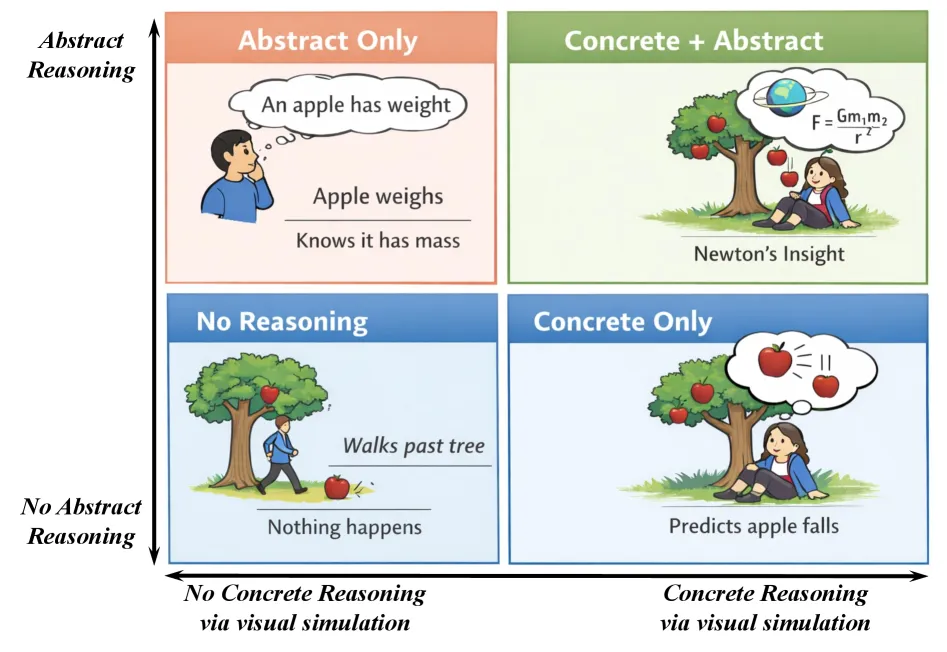
A multimodal LLM can reason about goals and rules in language; a video world model can roll out what a scene might look like a few frames later. PF-OPSD (Privileged-Future On-Policy Self-Distillation) is a training recipe that teaches a Qwen3.5-9B student to coordinate the two: decide when simulating the future helps, whether the generated rollout is credible, and how much it should sway the final answer.
The headline numbers, both verified on the paper’s tables: PF-OPSD scores 72.4% on VRQABench versus a 61.8% supervised-fine-tuning (SFT) baseline (+10.6 points), and 70.5% on OpenWorldQA versus 59.6% SFT (+10.9 points). The trick is that ground-truth future videos are used only on the teacher side during training; the deployed student never sees a true future at test time.
The actual problem: stochastic rollouts that look right but are wrong
Video world models such as Helios (the rollout engine used here) generate visually plausible futures, but those futures are stochastic. A rollout can look photorealistic and still be task-incorrect, e.g. it shows a ball settling in the wrong cup, or a maze agent walking through a wall. Naively feeding such a rollout into an MLLM is worse than ignoring it.
So the paper reframes the task as controlled concrete reasoning: the model must (1) invoke visual simulation only when it actually helps, (2) verify whether a given rollout is credible, and (3) integrate the credible part into an abstract chain of reasoning. That gating decision is the real contribution. Most “world-model-augmented” pipelines assume the rollout is trustworthy; this one assumes it usually is not.
How PF-OPSD works
The “privileged” idea borrows from privileged-information learning. During training, the teacher (a Gemini-3.1-Pro plus agent workflow) gets to see the ground-truth future video and the gold answer. It uses that privileged view to score the student’s own on-policy reasoning trajectories: was invoking the world model the right call, was the rollout judged credible correctly, did the integration step help?
The student is then self-distilled on its own good trajectories, weighted by that teacher signal. Because the supervision is on-policy (graded on what the student actually produced, not a fixed dataset), the student learns a calibrated policy for trusting or discarding rollouts. At deployment the privileged future is removed entirely, so there is no test-time leakage.
Inside the two benchmarks
The authors built two human-verified benchmarks because nothing existing isolated this skill.
- VRQABench (4,636 questions; ~4,000 train / 636 eval) targets controllable spatial lookahead, built on maze and Sokoban-style puzzles where the correct answer depends on simulating a few steps ahead.
- OpenWorldQA (4,404 questions; ~3,904 train / 500 eval) targets open-domain physical prediction from real video frames, drawn from sources like Charades, Something-Something V2 and Oops.
Two ablations are worth flagging because they show where the gain comes from. Removing rollout verification drops VRQABench from 72.4% to 65.2%; removing advantage weighting drops it to 66.4%. Both ablated variants still beat the 61.8% SFT baseline, which tells you the on-policy distillation itself does real work even before the verification machinery.
Why this matters now
Everyone is bolting video generators onto agents and assuming the simulation is a free oracle. This paper is a useful counterweight: the value is not the rollout, it is knowing when to ignore the rollout. A roughly +10-point swing from learning that gating, on a 9B student with no test-time access to true futures, is a clean result.
My honest take: the gains are real but the scope is narrow. Both benchmarks are image-conditioned, short-horizon, and the world model is doing a few-frame lookahead, not long planning. The teacher relies on a strong proprietary model (Gemini-3.1-Pro) plus an agent workflow, so reproducing the privileged signal is not cheap. If you work on long-horizon planning or interactive embodied control, this is a methodological seed, not a drop-in solution.
Key results
- +10.6 points on VRQABench: 72.4% (PF-OPSD) vs 61.8% (SFT baseline) with a Qwen3.5-9B student.
- +10.9 points on OpenWorldQA: 70.5% vs 59.6%.
- Verification matters most: ablating rollout verification costs 7.2 points (72.4% → 65.2%); ablating advantage weighting costs 6.0 points (→ 66.4%).
- No test-time leakage: ground-truth futures are teacher-only; the deployed student answers from the question and image alone.
- Handles bad rollouts better: the paper reports the model holds up against noisy or conflicting rollouts, which is the practical payoff of the gating policy.
Limits and open questions
- Image-conditioned, short horizon. The authors state conclusions apply most directly when the world model produces relevant futures; longer temporal horizons and interactive environments are out of scope.
- Expensive teacher. The privileged signal comes from a Gemini-3.1-Pro plus agent workflow with access to gold futures, so the recipe is hard to reproduce without strong proprietary models.
- Two benchmarks, one team. VRQABench and OpenWorldQA are new and human-verified, but external replication on independent tasks is still missing.
- World model dependence. Results lean on Helios-quality rollouts; a weaker generator could shift the trust calculus entirely.
This paper is one of the sources behind World Models vs LLMs.
FAQ
What does PF-OPSD actually train the MLLM to do?
It trains a Qwen3.5-9B model to treat a video world model as an unreliable advisor: invoke it only when simulation helps, verify whether each rollout is credible, and weight how much the rollout influences the final answer, rather than blindly trusting the generated future.
How big are the gains in World Models Meet Language Models?
PF-OPSD improves accuracy by 10.6 points on VRQABench (72.4% vs 61.8%) and 10.9 points on OpenWorldQA (70.5% vs 59.6%) over a supervised-fine-tuning baseline.
Does the model see the true future video at test time?
No. Ground-truth future videos and answers are used only as teacher-side privileged context during training. The deployed student never observes the true future and answers from the question and the static image alone.